

There is a moment —it always comes— when you stop trusting your own body.
By Ehab Soltan
HoyLunes – It does not happen when the temperature rises. It happens when a doubt appears. It is not a clear odor; it is not something others point out. It is worse: it is a silent suspicion.
In that instant, your body language changes without you deciding it. You cross your arms. You avoid wide movements. You apply more product than necessary. You mentally change your clothes three times before leaving.
That state of alertness has nothing to do with the thermometer.
It is not heat. It is insecurity.

Sweat is odorless: the diagnostic error that fuels the conflict
The first step toward understanding yourself is accepting a chemical truth: sweat does not smell. It is, in essence, a mixture of water and salts whose only mission is to prevent your brain from overheating.
The real conflict appears afterward. Odor is the result of the decomposition of lipids and proteins by the bacteria that inhabit your skin (Staphylococcus, Corynebacterium). You do not smell because you sweat; you smell because that interaction occurs under conditions that almost no one controls.
Research from the Mayo Clinic and the American Academy of Dermatology confirms that the goal should not be absolute dryness, but the management of the skin microbiota. If you treat sweat as the enemy, you are attacking the messenger, not the problem.
And these conditions are not the same for everyone. Factors such as skin type, hormonal balance, or even diet can intensify or soften this process without the person being aware of it.
The trap of the morning ritual: why you are late to your own physiology
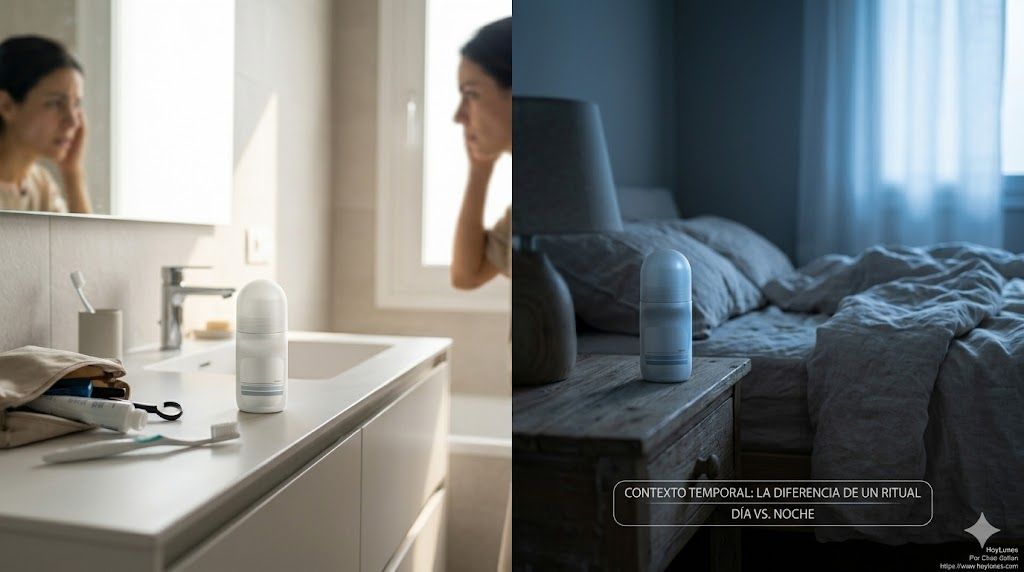
Almost all of us apply deodorant or antiperspirant upon leaving the shower, right before starting the day. It is logical, it is clean, but it is ineffective.
When you apply a product over an already active gland or skin that is increasing in temperature, absorption is minimal. The outflow of sweat expels the active ingredient before it can settle.
The simple decision: The key moment is the night.
The reason: During sleep, the sweat rate drops to its biological minimum. Applying it before bed allows the components to settle in the gland ducts while they are at rest.
It is not a hygiene trick; it is taking advantage of the circadian rhythm of your sweat glands. This is why many people feel that “by mid-morning it no longer works”, when in reality, it never fully worked at all.
The myth of the mask: when perfume becomes an amplifier
There is a belief that, when odor is suspected, more perfume equals more freshness. In reality, the body does not work by substitution, but by accumulation.
Perfume and degraded sweat do not cancel each other out; they mix. Ambient heat acts as a catalyst that makes the mixture heavier and more persistent. Attempting to “cover up” a bacterial process with synthetic fragrance usually generates an olfactory signature that is more aggressive and less natural than the body’s own scent.
Physiological elegance consists of neutrality, not saturation.
Clothing as a reservoir: the problem that is not in your skin
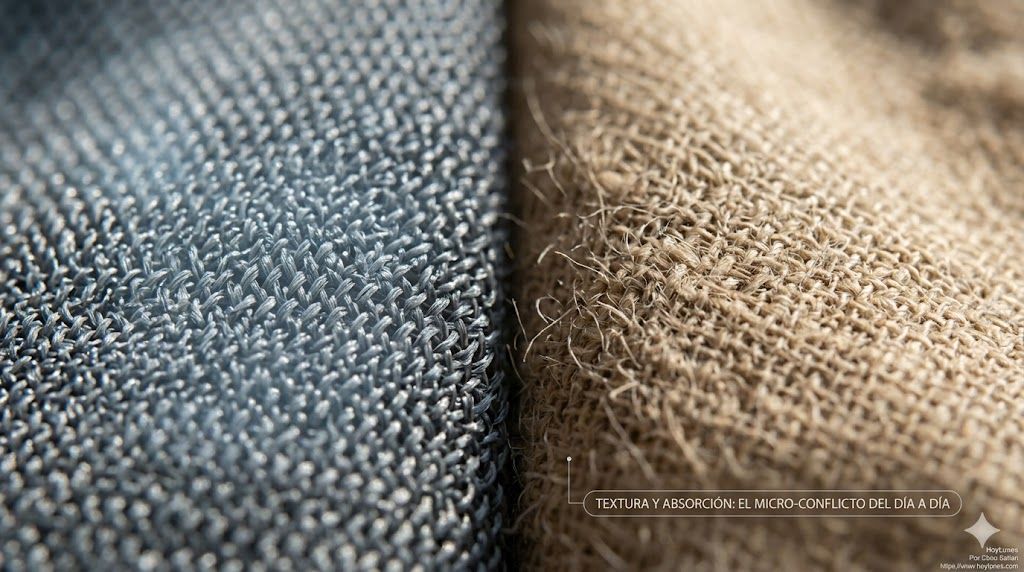
You can have impeccable hygiene and a perfect product strategy, yet still feel that the odor follows you. Often, the problem is not your body, but the bacterial memory of your fabrics.
Synthetic fabrics (polyester, nylon) act as oleophilic traps. They absorb fats from sweat and retain them even after a conventional wash cycle. Studies in applied microbiology show that bacteria proliferate more in these fibers than in natural ones.
The adjustment: Cotton or linen allow for better breathability and retain fewer of the compounds responsible for odor.
Sometimes, the solution to a “body doubt” is in the closet, not the pharmacy. This is why there are garments that, even when freshly laundered, generate doubt from the first use.
The invisible factor: when biology does not negotiate
In women, the body is not a constant; it is a cycle. The fluctuation of estrogen and progesterone alters basal temperature and the activity of sweat glands. It is not a subjective perception: at certain times, the composition of sweat changes.
Many women notice this especially in the days prior to menstruation, when body temperature rises slightly. It is not a lack of hygiene. It is a physiological adjustment.
Physical context also plays a role. Not for aesthetics, but for mechanics: increased friction and areas of accumulation facilitate the interaction between sweat and bacteria. It is physics, not judgment.
Added to this is stress. Sweat from heat is mostly water (eccrine glands), but stress sweat comes from apocrine glands, which are denser and richer in compounds that bacteria transform with ease. That is why a few minutes of tension on public transport can generate more discomfort than an hour of exercise.
What you eat also stays with you (even if you don’t notice it immediately)
Body odor does not start on the skin. It starts before.
Foods such as garlic, onions, alcohol, or certain spices can modify body odor hours after ingestion. It is not about avoiding them, but about understanding the context. A typical day is not the same as a day of heat, proximity, and constant movement.
When it is not just summer: the signal you should not ignore
There are cases in which sweating does not respond to heat or context. If it appears intensely even at rest, or in a persistent or localized manner (hands, feet, armpits), it may be hyperhidrosis.
It is not rare. It is not a lack of control. And in many cases, it has a hereditary component, as pointed out by organizations such as the International Hyperhidrosis Society. Understanding this difference prevents the frustration of trying to correct with habits what actually requires a different approach.
Stop fighting to start deciding
An excess of control—showering several times a day or using aggressive products—is often counterproductive. The Cleveland Clinic warns that radically eliminating the protective microbiota leaves the door open for the bacteria responsible for foul odor.
Understanding the constant adjustment of your body changes how you respond. The real change does not occur when you manage to never sweat, but when you understand that sweat is a vital function and that managing it depends more on timing, context, and small decisions than on force or obsession.
When you stop seeing your body as a system that fails and start seeing it as an organism that adapts, something relaxes.
Because when the doubt disappears, the body stops being a problem.
#EnvironmentalPhysiology #SystemicHealth #BodyAndScience #HoyLunes #EhabSoltan